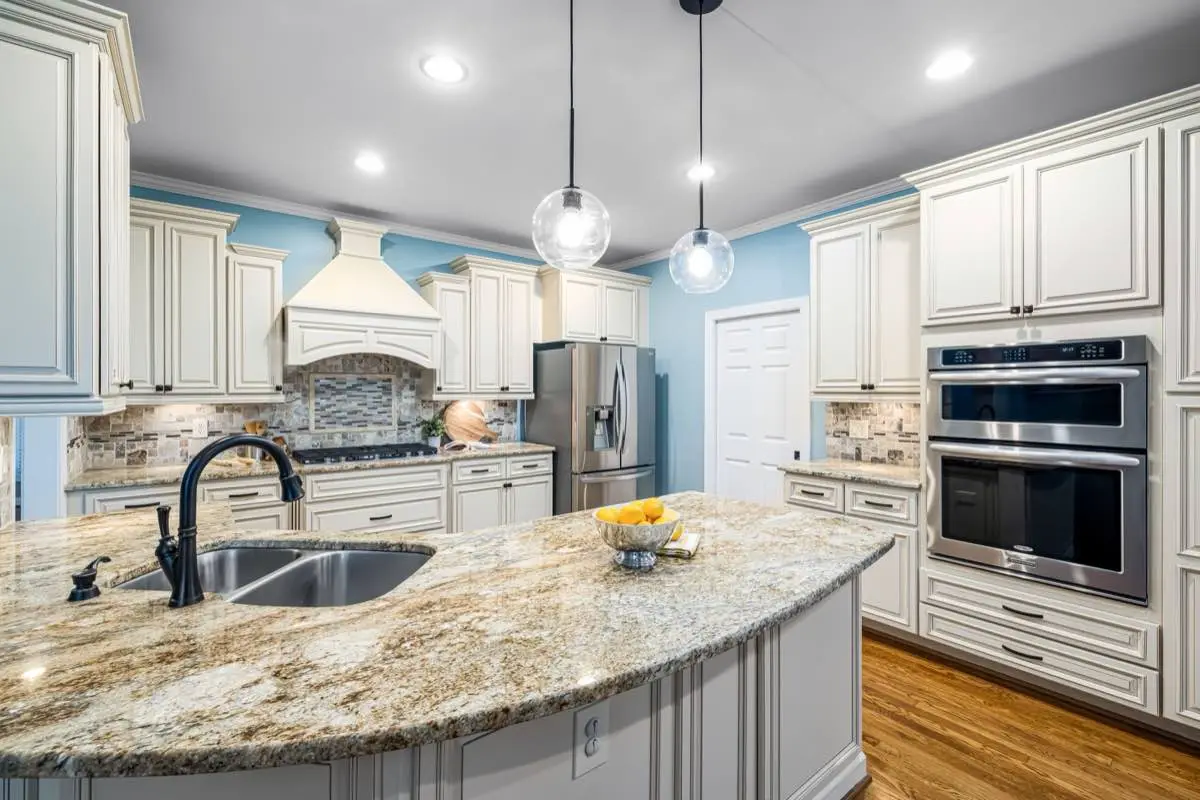
Shaker for most houses, flat panel for genuinely modern ones, and the price difference between them is smaller than the internet suggests. That's the whole answer. If you have five minutes rather than five seconds, the interesting part is that this decision is less about taste than about what your kitchen already is.
A five-piece Shaker door in a 1930s bungalow looks like it was always there. A high-gloss handleless slab in that same bungalow looks like a very confident spaceship landed in the kitchen. Neither door is wrong. One of them is arguing with the house.
What each one actually is
Shaker is a five-piece door: two vertical stiles, two horizontal rails, and a flat center panel that floats in a groove. The floating is deliberate — it lets a solid wood panel expand and contract seasonally without splitting the frame. That's a 200-year-old solution to a problem that still exists.
Flat panel, in real-world usage, almost always means a slab door: one flat piece, usually MDF or veneered plywood, with a finished or banded edge. No frame, no reveal, no shadow line. Strictly speaking a "flat panel" door is a framed door with a non-raised center, but nearly every showroom uses the term for slab.
Head to head
| Shaker | Flat panel / slab | |
|---|---|---|
| Construction | 5 pieces, 4 joints | 1 piece plus edge treatment |
| Cost | Slightly higher | Slightly lower |
| Cleaning | One dust line along the bottom rail | Wipe and done |
| Visual effect | Adds depth and shadow | Recedes, makes a room feel wider |
| Best with | Painted finishes, traditional and transitional homes | Wood veneers, high gloss, modern builds |
| Hardware | Needs pulls or knobs to read right | Works with integrated or edge pulls |
| Resale breadth | Widest | Narrower with bold colors, strong with wood tone |
| Damage repair | Panel can sometimes be replaced alone | Usually the whole door |
| Best rail width | 2 to 2.5 in classic, 3 in+ reads heavy | n/a |
The cost difference, in real numbers
Cabinet shops price by the linear foot, and door style is one of several inputs rather than the headline. Moving from slab to Shaker within the same tier typically adds somewhere in the range of 5 to 15 percent to the cabinet line — call it a few hundred dollars on a small kitchen and low thousands on a large custom one.
Which means door style is rarely the lever that fixes a budget. The tier is the lever — stock at roughly $100 to $300 per linear foot, semi-custom at $150 to $450, custom at $500 to $1,200 and up. We laid all of that out in how much kitchen cabinets cost.
The details that actually decide how it looks
Within Shaker, the variables matter more than the label:
- Rail and stile width. Classic Shaker is about 2 to 2.5 inches. Go to 3 inches or wider and the door starts reading heavy and farmhouse. Go narrow, around 1.75, and it reads modern and tailored.
- Inside edge profile. A square inside edge is the true Shaker look. A small bead or an ogee inside edge is a different style wearing a Shaker name tag.
- Panel material. MDF for paint, real wood for stain. Do not accept a solid wood center panel on a painted door if you can avoid it.
- Overlay. Full overlay covers nearly the whole face frame and looks current. Partial overlay leaves a wide frame reveal and reads dated to most eyes.
Within slab, the variables are:
- Edge banding. A cheap PVC band with a visible seam undoes an expensive door. Ask for matching or laser-applied edge.
- Grain direction. On a wood veneer, running the grain horizontally across a full wall of cabinets is the move that makes it look designed.
- Sheen. High gloss shows every fingerprint. Matte and satin do not, and matte has been the stronger look for a while.
Our one strong opinion
If you're painting, choose Shaker with an MDF center panel. If you're going with a natural wood tone, choose slab.
The reasoning isn't aesthetic, it's material. Paint on a five-piece door with a solid wood panel will eventually crack along the line where the panel meets the rail, because that panel moves a little with every change of season and a cured paint film has no give in it. On an MDF panel it never happens, because MDF is dimensionally stable. Painted MDF Shaker is the most durable painted door available, full stop.
Meanwhile, a wood grain looks its best when it runs continuously across a face without being interrupted by four joints. A walnut or white oak slab shows the material. A walnut Shaker chops it into five pieces and quietly wastes the nicest thing about it.
What actually makes a kitchen look dated
Not the door style. Three other things:
- Partial overlay with wide face frame reveals between every door.
- Ornate profiles — raised panels, cathedral arches, heavy applied molding.
- Hardware from a specific decade, which is the cheapest of the three to fix.
Shaker and slab both survive because neither one is doing anything fashionable. They're doing nothing, confidently, which turns out to age extremely well.
When you shouldn't replace the doors at all
Here's where we talk you out of a job. If your boxes are solid and your only complaint is the door style, you don't need new cabinets — you need refacing. New doors and drawer fronts over your existing boxes runs about $4,000 to $10,000 and takes roughly a week, against $15,000 to $40,000 and several weeks for a replacement. The whole decision tree is in cabinet refacing vs replacing.
And if the doors are actually fine and it's the color you've grown tired of, that's smaller still. Refinishing solid wood doors — sand, prime, spray — costs less than refacing and changes the room completely.
Cheapest option of all: swap the hardware, and see how you feel in a month. Twenty pulls and a Saturday can genuinely reset a kitchen, and it costs less than the deposit on new doors.
Bottom line
Shaker if you're painting, if the house has any traditional bones, or if resale breadth matters. Slab if you're showing off a wood grain or the house is genuinely modern. Then spend your real attention on rail width, overlay, and edge banding, because those decide whether either one looks expensive.
Laredo Elite Cabinets builds custom kitchen cabinets in both, handles cabinet refacing when the boxes are worth keeping, and does matching bathroom vanities across Laredo and Webb County. Bring us a photo of your kitchen and we'll tell you which door your house is asking for. Call (888) 440-5106.
Ready for a free quote in Laredo?
Laredo Elite Cabinets — free estimate, clear scope, no pressure. Use the form on this page or jump to the homepage quote.
Related services in Laredo
Laredo Elite Cabinets money pages — go straight to the service you need.
- Custom Kitchen Cabinets →
Custom kitchen cabinets in Laredo get judged by one thing: whether three people can cook in the room at once without anybody backing into a hot pan. We build ours in 3/4-inch furniture-grade plywood with dado-and-glue joinery, solid maple dovetail drawer boxes and full-extension Blum undermount slides, framed or frameless depending on the look you are after.
- Bathroom Vanities →
Bathroom vanity cabinets in Laredo fail from the bottom up, because the water here is mineral-heavy enough to scale an aerator in a couple of months and the cabinet floor under the trap stays damp far longer than anyone admits. We build vanities in 3/4-inch plywood with a sealed base and a drip tray under the plumbing, never particleboard, and notch the drawer boxes around the P-trap so you get storage instead of a cave.
- Cabinet Refacing, Refinishing & Painting →
Cabinet refacing and refinishing is the right call more often than a cabinet shop likes to admit, and in Laredo's 2000s and 2010s subdivisions it is usually the answer, since the boxes are square and sound while the thermofoil doors above the range have peeled off their cores. Refacing swaps every door, drawer front, hinge and slide and skins the face frames in matching veneer, generally $4,000 to $10,000 against $15,000 and up for new cabinets.
- Walk-In Closets & Wardrobes →
A custom closet system in Laredo does its real work in houses where four adults share two closets, which describes a lot of Webb County. We build floor-based systems in 3/4-inch plywood with adjustable shelving on 32mm boring, full-extension drawers and doors on the sections that need them, anchored into studs rather than hung off drywall anchors and optimism.
- Garage Cabinets & Storage →
Garage cabinets and storage in Laredo have to survive a room that hits 110 degrees by two in the afternoon and takes on a fresh coat of caliche dust every time the wind picks up. We build garage storage as closed casework: plywood cases surfaced in high-pressure laminate or sprayed in catalyzed conversion varnish, doors on everything, uppers hung off a ledger into studs or sleeve-anchored into block.
Frequently asked questions
Which is cheaper, Shaker or flat panel?
Flat panel, usually by a small margin. A slab door is one piece of material with an edge treatment. A five-piece Shaker door is exactly what it sounds like — two stiles, two rails and a center panel, with four joints to cut and glue — so there is more machining and more assembly. On a 25-linear-foot kitchen the gap is real but rarely the deciding factor, often a few hundred to a couple of thousand dollars.
Are Shaker cabinets going out of style?
Shaker has been in continuous production since the 1800s and has survived every kitchen trend since. Calling it dated is a bit like calling a white shirt dated. What does date is the specific rail width, the color, and the hardware, all of which are cheaper to change than the doors.
Are Shaker cabinets hard to clean?
The recessed center panel collects a thin line of dust and cooking film along the bottom rail. It takes a damp cloth and about four seconds per door. Flat panel genuinely is easier, since there's nothing to catch. Anyone who tells you Shaker doors are a cleaning nightmare has not met a Shaker door.
What is the difference between flat panel and slab doors?
In practice they're used interchangeably, but strictly a slab door is one solid piece with no frame at all, while a flat panel door has a frame with a flat, non-raised center. Most modern kitchens marketed as flat panel are actually slab doors.
Which door style is better for resale?
Shaker, in most markets, because it reads as neutral to the widest range of buyers and doesn't commit the kitchen to a specific era. Slab doors in a warm wood veneer are the strong second, especially in newer homes. High-gloss colored slab is the one that narrows your buyer pool.
Can you get Shaker doors in MDF?
Yes, and for painted cabinets an MDF center panel is actually the better choice. Solid wood panels expand and contract with seasonal humidity, which eventually cracks the paint line where the panel meets the frame. MDF doesn't move, so a painted MDF Shaker door stays crisp for decades.
Local context
How this applies in Laredo, TX
Every article here is written from cabinet work done in Laredo and Webb County, so the numbers reflect local labour, permit and material costs rather than a national average. Your own job can land either side of them depending on access, the condition of what is already there, and the materials you pick — furniture-grade plywood boxes, solid maple dovetail drawers, Blum and Grass soft-close hardware.
The way to turn any of this into a real answer is to have someone look at your actual situation. The free estimate is free, itemized and written down, with no deposit and no obligation. Call (888) 440-5106 or start on the Laredo Elite Cabinets homepage.
Areas Laredo Elite Cabinets covers
Laredo first, then the surrounding communities of Webb County. Each has its own page with local detail rather than a copy of this one:
- Rio Bravo, TX — Webb County, population 4,450
- El Cenizo, TX — Webb County, population 2,540
- Zapata, TX — Zapata County, population 5,383
- San Ygnacio, TX — Zapata County, population 504
- Hebbronville, TX — Jim Hogg County, population 4,101
- Cotulla, TX — La Salle County, population 3,718
Or jump to the full list of Laredo services.
More from the Laredo Elite Cabinets blog
- Painted vs Stained Cabinets: A Laredo Verdict
Painted vs stained kitchen cabinets in Laredo, TX — why paint costs more, which one hides wear, and the joint-crack problem nobody warns you about.
- Kitchen Cabinet Organization for Laredo Homes
Kitchen cabinet organization for Laredo, TX — pull-outs, corner solutions, trash and tray storage, what each costs, and which ones are worth skipping.
- Cabinet Hardware Trends in Laredo Kitchens
Kitchen cabinet hardware trends in Laredo, TX — which finishes hold up, the pull-length rule that fixes sizing, and how to swap 40 pulls yourself.
The Laredo Elite Cabinets Team
cabinet specialists serving Laredo, TX
Written by the Laredo Elite Cabinets team — insured cabinet pros with 15+ years serving Laredo, TX and the surrounding area.