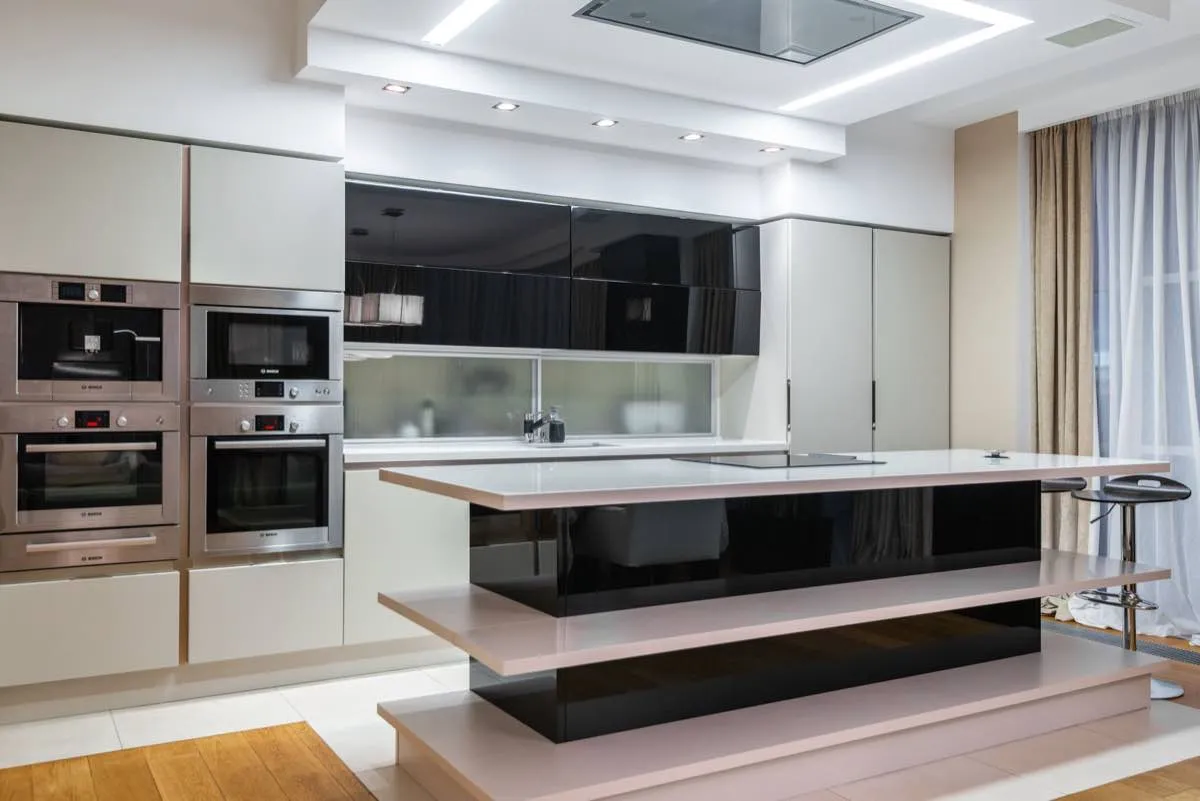
Custom built-ins run roughly $250 to $700 per linear foot installed, so a 10-foot bookcase wall commonly lands between $2,500 and $5,000 and a full entertainment wall with lighting and doors runs $6,000 to $15,000. That's more than furniture. What you're buying is the part furniture can't do: a wall that ends exactly where the wall ends.
There's a specific feeling that makes people search for this. You've got a nice bookcase in the living room, it's two inches shy of the corner, and there's a permanent dust colony living in that gap. You've made peace with it. Sort of. You think about it most weeks.
What "built-in" actually buys you
- Wall-to-wall fit in a room where nothing is square, which is every room.
- Scribe to the wall. A finish carpenter cuts the side panel to follow the wall's actual waves. Furniture just sits there and lets you see the gap.
- Full height. Furniture stops at 84 inches because it has to fit through a door. Built-ins can run to the ceiling with crown returning into it.
- No tip hazard, since it's fastened to studs. This matters more than people think with kids in the house.
- Integrated everything: lighting, outlets, cable pass-throughs, HVAC returns worked around rather than blocked.
That's the honest list. Nowhere on it is "cheaper," and any shop that leads with cheaper is measuring a different job than the one you want.
Cost by room and complexity
| Project | Typical installed range | Notes |
|---|---|---|
| Open bookcase wall, 8–10 ft | $2,500–$5,000 | Mostly shelving, minimal doors |
| Fireplace flanking cabinets, pair | $3,500–$8,000 | Base doors, upper shelves, matching trim |
| Entertainment wall with media base | $6,000–$15,000 | Doors, drawers, lighting, ventilation, cable runs |
| Home office wall with desk | $5,000–$12,000 | Desk surface, file drawers, wire management |
| Mudroom lockers, 6–8 ft | $3,000–$7,000 | Bench, cubbies, hooks, closed upper storage |
| Window seat with drawers | $1,800–$4,500 | Bench box, lift-top or drawers, trim |
| Under-stair storage | $2,000–$6,000 | Angled work, the most custom thing in any house |
Per linear foot, open shelving sits at the low end and anything with doors, drawers and a finished interior sits at the high end. Doors and drawers are where the labor lives — each one is a box, a front, hinges, alignment, and a finish pass.
Shop-built vs site-built
Shop-built means the units are made in a controlled space, sprayed with conversion varnish or catalyzed lacquer under proper conditions, then delivered and installed. Better finish, less dust in your house, and 3 to 6 weeks of lead time. This is how most quality built-ins get made.
Site-built means a carpenter frames and finishes it in place over about a week. Handles genuinely strange spaces better — an under-stair nook, a room with a 4-inch bow in the wall — but the finish is brushed or sprayed in your living room, which is exactly as fun as it sounds.
Most good jobs are a hybrid: shop-built boxes and doors, site-installed with scribe panels, fillers and trim fitted to the actual wall.
Materials that matter
Boxes: furniture-grade plywood, 3/4 inch for anything spanning more than 32 inches. Particleboard sags. A loaded 36-inch particleboard shelf will develop a visible smile within a couple of years, and it never un-smiles.
Face frames: poplar is the standard for paint-grade because it's stable, cheap, and machines cleanly. Maple or the matching species for stain-grade.
Door panels: MDF center panels for painted doors. Solid wood panels expand and contract seasonally and eventually crack the paint line at the rail-and-stile joint. MDF doesn't move, so painted MDF panels stay crisp.
Finish: conversion varnish or catalyzed lacquer, sprayed. Wall paint on cabinetry is a mistake you'll notice within a year, when the shelf edges start showing wear you can't wipe off.
Shelf spans: keep loaded shelves under 32 inches between supports, or add a center partition, or use 1-inch stock. Books are heavier than the internet lets people believe.
Our one strong opinion about built-ins
Spend on doors and drawers in the bottom third, and go open above. Not because it looks better, though it does. Because closed lower storage is where the ugly stuff goes, and open upper shelving costs roughly half what closed cabinetry costs per foot.
A 10-foot wall built as full closed cabinetry might run $6,000. The same wall with a 30-inch closed base and open shelves above lands closer to $3,500, holds the same amount, and looks less like a wall of doors. You're paying for the exact storage you need and not paying for doors on the shelves that hold books nobody minds seeing.
The exception is a media wall, where closed storage hides the box of tangled cables that every household owns and nobody admits to.
When to buy furniture instead
We'd genuinely rather you knew this before spending five thousand dollars.
Buy furniture if you might move within a couple of years. Built-ins stay with the house. The money does not come back at closing in any reliable way.
Buy furniture if you rent. Obviously, but it comes up.
Buy furniture if the wall is straight, the ceiling is standard, and the room is a rectangle. In a newer build with square walls and 8-foot ceilings, a good freestanding bookcase pushed to the wall with a strip of scribe molding along the side gets you 85 percent of the look for a tenth of the price. A $30 tube of caulk and a $12 piece of trim closes the dust gap that started this whole search.
And if you just need a closet to work harder, a closet system costs a fraction of built-in cabinetry and solves more storage per dollar than anything else in the house.
Where built-ins genuinely earn it: awkward geometry, tall ceilings, a fireplace wall, a mudroom that takes daily abuse, or a home office you'll use for years.
Bottom line
Budget $250 to $700 per linear foot, more when doors and lighting are involved. Buy plywood boxes, MDF paint-grade panels, and a sprayed finish. Go closed low and open high. And skip the whole thing if the wall is square and you might move.
Laredo Elite Cabinets builds custom built-ins and entertainment centers, closet systems, and custom kitchen cabinetry across Laredo and Webb County — measured, drawn, and shop-finished before anything comes through your door. If you want a drawing and a real number, call (888) 440-5106. If you want to know how cabinetry gets priced generally, that's in how much kitchen cabinets cost.
Ready for a free quote in Laredo?
Laredo Elite Cabinets — free estimate, clear scope, no pressure. Use the form on this page or jump to the homepage quote.
Related services in Laredo
Laredo Elite Cabinets money pages — go straight to the service you need.
- Custom Kitchen Cabinets →
Custom kitchen cabinets in Laredo get judged by one thing: whether three people can cook in the room at once without anybody backing into a hot pan. We build ours in 3/4-inch furniture-grade plywood with dado-and-glue joinery, solid maple dovetail drawer boxes and full-extension Blum undermount slides, framed or frameless depending on the look you are after.
- Walk-In Closets & Wardrobes →
A custom closet system in Laredo does its real work in houses where four adults share two closets, which describes a lot of Webb County. We build floor-based systems in 3/4-inch plywood with adjustable shelving on 32mm boring, full-extension drawers and doors on the sections that need them, anchored into studs rather than hung off drywall anchors and optimism.
- Home Office & Built-Ins →
Home office built-ins in Laredo usually start with a customs broker who has been working off the dining table since the freight stopped keeping office hours. We build desks, file walls and bookcases as furniture rather than boxes: plywood carcasses, hardwood face frames or frameless with 3mm edge banding, scribed tight so the finished wall reads as part of the house.
- Bathroom Vanities →
Bathroom vanity cabinets in Laredo fail from the bottom up, because the water here is mineral-heavy enough to scale an aerator in a couple of months and the cabinet floor under the trap stays damp far longer than anyone admits. We build vanities in 3/4-inch plywood with a sealed base and a drip tray under the plumbing, never particleboard, and notch the drawer boxes around the P-trap so you get storage instead of a cave.
- Garage Cabinets & Storage →
Garage cabinets and storage in Laredo have to survive a room that hits 110 degrees by two in the afternoon and takes on a fresh coat of caliche dust every time the wind picks up. We build garage storage as closed casework: plywood cases surfaced in high-pressure laminate or sprayed in catalyzed conversion varnish, doors on everything, uppers hung off a ledger into studs or sleeve-anchored into block.
Frequently asked questions
How much do custom built-ins cost?
Most paint-grade built-ins run roughly $250 to $700 per linear foot installed, depending on how much of the run is open shelving versus doors and drawers. A 10-foot bookcase wall commonly lands around $2,500 to $5,000. A full entertainment wall with integrated lighting, doors, and cable management is more often $6,000 to $15,000.
Are built-ins cheaper than buying furniture?
Usually not, and that's the wrong comparison. A decent bookcase from a furniture store costs a few hundred dollars. Built-ins cost multiples of that and buy you a wall-to-wall fit, no dust gap behind, no tipping hazard, and trim that matches the room. You pay for fit and permanence, not for shelves.
Do built-ins add value to a home?
Well-made ones in the right room help a house show better, particularly a home office or a living room focal wall. Cheap particleboard boxes screwed to a wall can actively hurt, because a buyer sees something they'll have to remove. Build them to the same standard as your kitchen cabinets or don't build them.
What material should built-ins be made from?
Paint-grade built-ins are usually furniture-grade plywood boxes with a poplar or MDF face frame and MDF door panels, because MDF takes paint without telegraphing wood grain or joint lines. Stain-grade means matching real wood species and veneer throughout, which costs more and takes longer.
How long do built-ins take to install?
For a shop-built unit, figure 3 to 6 weeks of build time after the measure and drawings, then 1 to 3 days on site. Site-built work happens entirely at your house over roughly a week, with more dust and more disruption but better handling of walls that are out of square.
Can built-ins go in a rental or a house I'll sell soon?
In a rental, no, unless the landlord is paying. In a house you're selling within a year, the money almost never comes back in the sale price. Freestanding furniture that leaves with you is the better call in both cases.
Local context
How this applies in Laredo, TX
Every article here is written from cabinet work done in Laredo and Webb County, so the numbers reflect local labour, permit and material costs rather than a national average. Your own job can land either side of them depending on access, the condition of what is already there, and the materials you pick — furniture-grade plywood boxes, solid maple dovetail drawers, Blum and Grass soft-close hardware.
The way to turn any of this into a real answer is to have someone look at your actual situation. The free estimate is free, itemized and written down, with no deposit and no obligation. Call (888) 440-5106 or start on the Laredo Elite Cabinets homepage.
Areas Laredo Elite Cabinets covers
Laredo first, then the surrounding communities of Webb County. Each has its own page with local detail rather than a copy of this one:
- Rio Bravo, TX — Webb County, population 4,450
- El Cenizo, TX — Webb County, population 2,540
- Zapata, TX — Zapata County, population 5,383
- San Ygnacio, TX — Zapata County, population 504
- Hebbronville, TX — Jim Hogg County, population 4,101
- Cotulla, TX — La Salle County, population 3,718
Or jump to the full list of Laredo services.
More from the Laredo Elite Cabinets blog
- Cabinet Refacing vs Replacing (Laredo Guide)
Reface if the boxes are solid and the layout works; replace if they're damaged or the layout changes. Real costs and timelines for Laredo, TX.
- Bathroom Vanity Ideas That Work in Laredo Homes
The best bathroom vanity ideas start with the opening you have: 30, 36, 48 or 60 inches. Sizes, storage and moisture-proof builds for Laredo, TX.
- Semi-Custom vs Custom Cabinets: Laredo Guide
Stock vs semi-custom vs custom cabinets on cost, sizing, lead time and quality — plus which tier is actually worth it in a Laredo, TX kitchen.
The Laredo Elite Cabinets Team
cabinet specialists serving Laredo, TX
Written by the Laredo Elite Cabinets team — insured cabinet pros with 15+ years serving Laredo, TX and the surrounding area.